The European payments industry is evolving rapidly.
From instant payments and Open Banking to the upcoming PSD3 framework and stronger fraud prevention measures, payment institutions are operating in an increasingly complex regulatory environment.
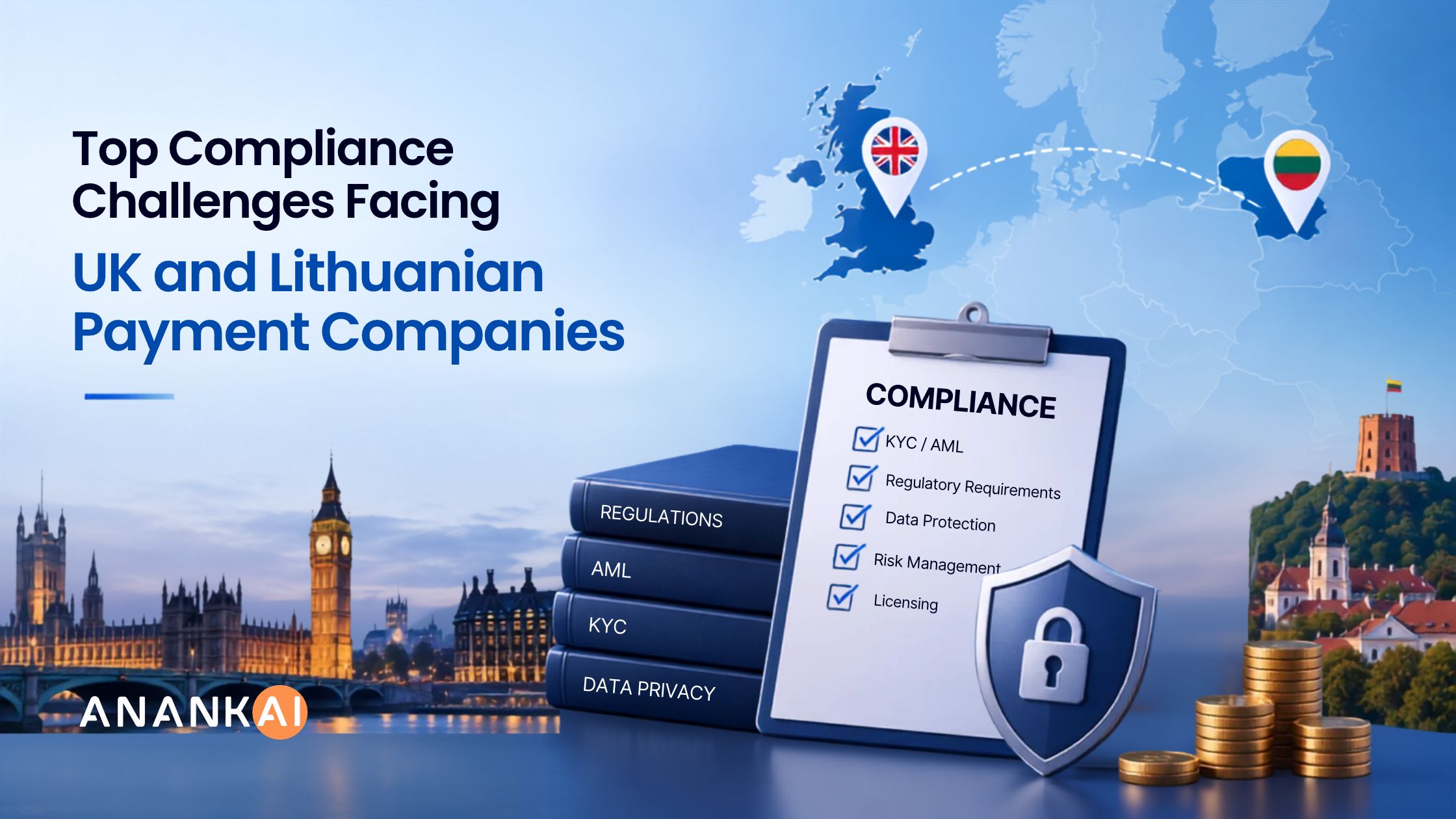
For UK Payment Institutions, Electronic Money Institutions (EMIs), and Lithuania’s thriving fintech ecosystem, compliance is no longer simply about meeting regulatory requirements, it’s about building operational resilience, protecting customers, and enabling sustainable growth.
The challenge is clear: How can payment companies strengthen compliance without slowing innovation?
A New Era of Compliance
Payment providers today face significantly higher expectations than they did just a few years ago.
Regulators increasingly expect firms to demonstrate:
- Strong governance
- Effective AML controls
- Real-time fraud detection
- Secure customer onboarding
- Operational resilience
- Comprehensive audit trails
- Robust risk management
At the same time, customers expect instant payments, seamless onboarding, and frictionless digital experiences.
Meeting both expectations requires modern technology rather than additional manual processes.
Challenge 1: Increasing AML Requirements
Anti-Money Laundering (AML) remains one of the most resource-intensive compliance responsibilities.
Payment companies must:
- Monitor transactions continuously
- Detect suspicious activity
- Investigate alerts
- Maintain evidence
- Report where required
As transaction volumes grow, manual monitoring becomes increasingly difficult.
Automated AML workflows enable institutions to focus compliance teams on higher-risk activities while improving consistency and operational efficiency.
Challenge 2: Faster Customer Onboarding
Customers expect to open accounts within minutes—not days.
However, payment firms must still complete:
- Identity verification
- Business verification (KYB)
- Risk assessments
- Sanctions screening
- Politically Exposed Person (PEP) checks
Balancing customer experience with regulatory obligations remains one of the industry’s biggest operational challenges.
Embedding KYC and KYB into onboarding workflows helps reduce friction while maintaining robust controls.
Challenge 3: Fraud Prevention in the Era of Instant Payments
Instant payments leave very little time to identify fraudulent activity before funds move.
As real-time payments become standard across Europe, institutions need technology capable of:
- Monitoring transactions in real time
- Applying configurable risk rules
- Generating immediate alerts
- Supporting rapid case investigation
Fraud prevention is increasingly becoming an operational capability rather than simply a compliance requirement.
Challenge 4: Preparing for PSD3 and PSR
The forthcoming Payment Services Directive 3 (PSD3) and Payment Services Regulation (PSR) will introduce updated expectations around fraud prevention, consumer protection, operational resilience, and payment service governance.
For payment providers operating across the UK and Europe, preparation involves more than understanding new rules—it requires infrastructure that can adapt as regulations evolve.
Building flexible, API-first platforms today helps reduce future implementation challenges.
Challenge 5: Managing Compliance Across Multiple Markets
Many UK fintechs serve customers across Europe, while Lithuanian EMIs frequently operate in multiple EEA countries.
Operating internationally often means managing:
- Different customer segments
- Multiple payment partners
- Cross-border payment flows
- Varying reporting requirements
- Diverse operational processes
Without integrated systems, compliance can become fragmented and resource-intensive.
A unified operational platform helps standardise workflows while supporting international growth.
Challenge 6: Audit Readiness and Regulatory Reporting
Regulators increasingly expect payment institutions to demonstrate not only compliance but also effective governance.
Maintaining audit-ready records requires:
- Complete activity logs
- Document management
- Case histories
- Workflow tracking
- Evidence retention
Automating these processes improves transparency while reducing administrative overhead.
Challenge 7: Scaling Without Increasing Operational Costs
Growth should not require proportional increases in compliance staffing.
Modern payment companies are investing in automation to:
- Reduce repetitive manual work
- Improve operational efficiency
- Accelerate investigations
- Enhance reporting accuracy
- Support larger transaction volumes
Compliance automation enables organisations to scale more sustainably while maintaining strong governance.
Why Technology Is the Answer
The most successful payment companies are moving away from disconnected compliance tools towards integrated platforms that combine operations, payments, and compliance.
A modern compliance platform should provide:
- Automated AML workflows
- KYC and KYB verification
- Transaction monitoring
- Risk scoring
- Case management
- Audit trails
- API integrations
- Operational dashboards
By embedding compliance into everyday operations, institutions can improve efficiency while strengthening risk management.
How AnankAI Helps Payment Companies Stay Ahead
At AnankAI, we provide compliance-embedded fintech infrastructure designed for EMIs, PSPs, and payment institutions.
Our platform includes:
Rather than treating compliance as a separate system, we integrate it into the operational workflow, helping payment companies improve efficiency while preparing for future regulatory developments.
Conclusion
Compliance is no longer just a regulatory obligation—it has become a competitive advantage.
Payment companies that automate compliance processes, modernise their infrastructure, and adopt scalable technology will be better positioned to support growth, improve customer experiences, and respond to evolving regulations.
For UK payment firms and Lithuanian EMIs alike, the future belongs to organisations that view compliance as an integrated part of their technology strategy rather than an operational burden.
Build a Compliance-Ready Payment Platform with AnankAI
Whether you’re modernising your payment infrastructure or preparing for the next phase of regulatory change, AnankAI provides the technology foundation to help you scale with confidence.
Book a personalised demo today to discover how our compliance-embedded fintech platform can support your business across the UK and Europe.