
Launching a Digital Wallet in Weeks
A faster way for fintechs to launch a branded digital wallet with everything you need wallet infrastructure, onboarding, payments, monitoring, and more.
The Challenge
The client wanted to launch a digital wallet that would allow customers to open accounts, hold funds, make payments and transfers, and manage their financial activity through a branded mobile application.
The team initially faced several bottlenecks:
- Developing wallet and account infrastructure from the ground up
- Creating a secure mobile experience for customers
- Integrating KYC/KYB and compliance providers
- Connecting with payment and card service providers
- Building transaction monitoring and operational workflows
- Creating dashboards for customer and transaction management
- Ensuring the platform could support future growth without a complete rebuild
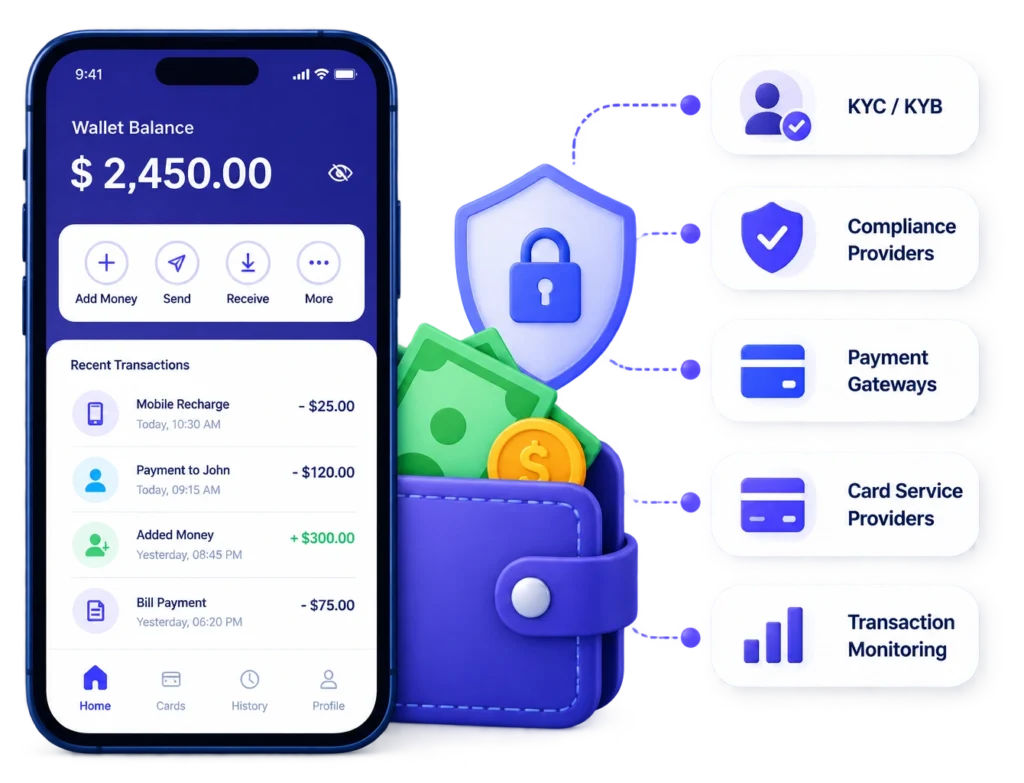
For a growing fintech, developing every component independently would mean a longer development cycle, higher engineering costs, and greater operational complexity.
So, the client decided to go with a technology partner, AnankAl.
The Goal
The objective was to launch a branded digital wallet platform within weeks. It could support both the customer-facing experience and the operational requirements behind it.
Launch faster within weeks
Create a branded experience
Simplify integrations
Strengthen operational visibility
Be scalable
The Solution
We implemented its digital wallet infrastructure as the technology layer behind the client’s financial product.
Rather than developing individual components in isolation, they could use AnankAI’s modular infrastructure to integrate key wallet capabilities.
Our platform supports customer accounts, multi-currency wallets, payments and transfers, KYC/KYB workflows, AML monitoring, reporting, and API-based integrations.
DIGITAL WALLETS & ACCOUNTS
The platform was configured to support:
- Customer account creation
- Wallet creation and management
- Balance management
- Transaction history
- Wallet-to-wallet transfers
- Payment workflows
- Multi-currency support
- Customer and business account structures
White-Label Mobile Application
The application was configured around:
- Brand identity
- Colours
- Logo
- User interface
- Customer journeys
- Wallet features
- Transaction experience
The result was a customer-facing application in which the technology remained behind the scenes, while the client maintained ownership of the customer experience.
KYC/KYB-Enabled Onboarding
Customer onboarding was integrated into the wallet journey.
Depending on the customer type, the onboarding workflow could support identity verification, business verification and other compliance checks through integrated third-party providers.
AnankAI provides the technology framework and integrations for KYC, KYB, AML and verification workflows rather than acting as the regulated financial institution or independently performing regulatory authorisation.
Payment Monitoring
AnankAI’s transaction monitoring capabilities enabled the team to monitor wallet and payment activity, configure monitoring rules, and manage alerts through an operational environment.
This gave the operations team greater visibility without requiring them to build a separate monitoring layer.
Card Management
The client also wanted the option to extend its wallet into card-based financial services.
Our infrastructure allowed card functionality to be connected through relevant card programme and processor integrations, giving the fintech a path to introduce virtual and physical card products without rebuilding its wallet architecture.
API Integrations
A major part of the implementation was connecting the client’s wallet with its wider fintech ecosystem.
AnankAI’s API-first architecture allowed the platform to connect with external services and providers while keeping the wallet layer at the centre of the product.
The integration layer was designed to support:
- KYC/KYB providers
- Payment providers
- Card processors
- Banking partners
- Compliance services
- Internal business systems
- Customer-facing applications
Our Implementation Approach
The implementation was divided into several stages.
Product Discovery
Our product and implementation teams worked with the client to understand:
Target customers
Wallet use cases
Account structures
Transaction flows
Third-party integrations
Onboarding requirements
Payment requirements
Card requirements
Reporting needs
Platform Configuration
The wallet environment, customer journeys, roles, transaction workflows and operational features were configured.
Integrations
Required KYC/KYB, payment, card, and other third-party integrations were connected through APIs.
Mobile Application
The white-label mobile application was configured around the client’s brand and customer journeys.
Testing
The teams tested onboarding, wallet creation, transactions, payments, notifications, monitoring, and operational workflows before production deployment.
Launch & Optimisation
After launch, the platform was monitored and refined based on customer behaviour, operational requirements and product priorities.
Ready to Build Your Digital Wallet?
Talk to us about your wallet use case, integrations and technology requirements.