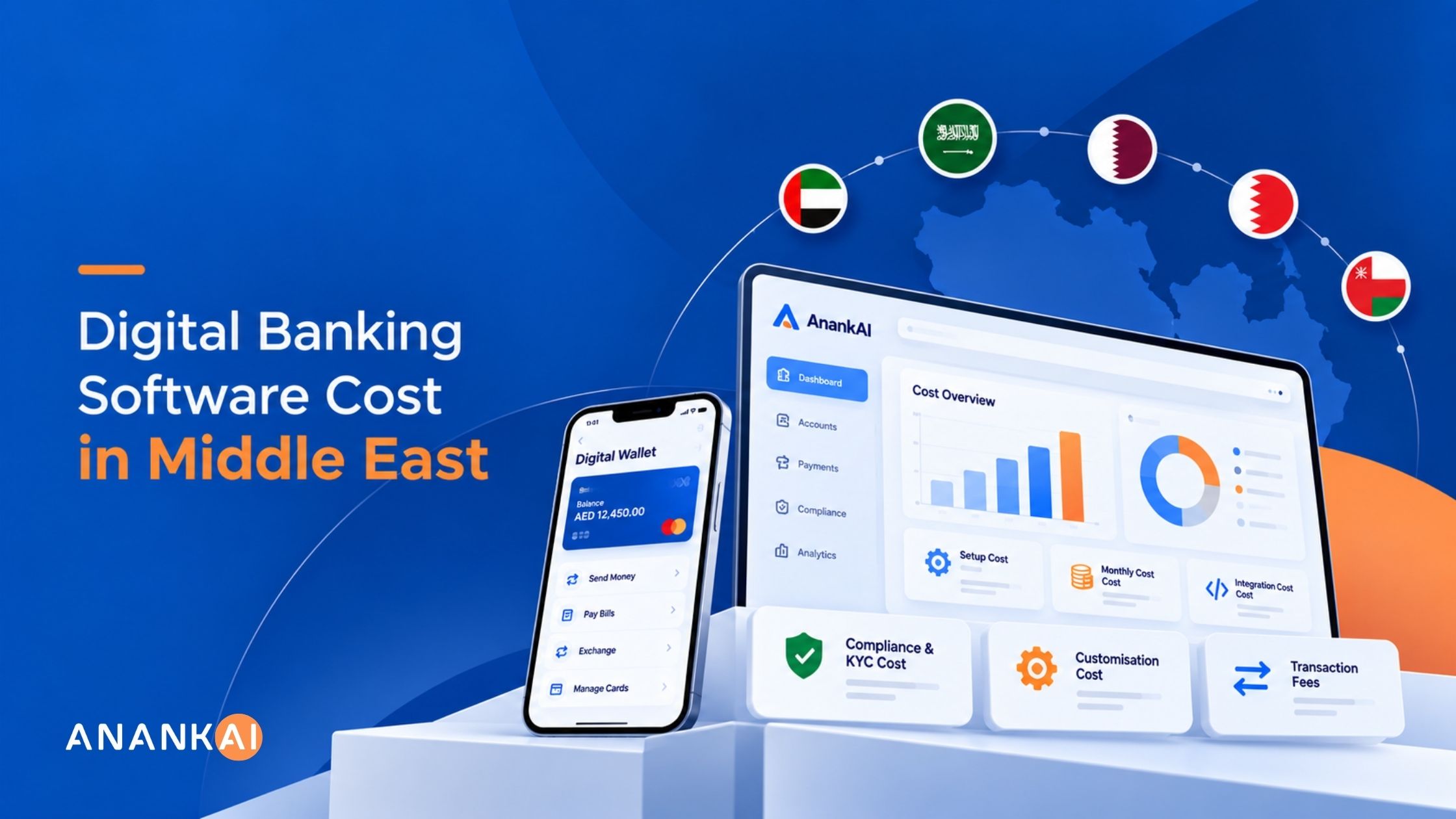
Digital Banking Software Cost in the Middle East
The cost of digital banking software in the Middle East varies significantly based on the platform, features, integrations, implementation model and regulatory requirements.
Read this blog to understand the cost components.
What Determines Digital Banking Software Cost?
Digital banking software is rarely priced as a simple one-time licence. Most modern platforms use subscription, usage-based, modular or customised pricing models.
The overall cost generally depends on the following:
1. Platform and Software Fees
The base platform cost depends on the capabilities required. A fintech launching a basic digital wallet will have different requirements from a bank building a complete digital banking platform.
Common modules can include:
- Digital accounts and wallets
- Core banking
- Payment processing
- Card management
- Customer onboarding
- KYC/KYB
- AML and sanctions screening
- Transaction monitoring
- Reconciliation
- Reporting and analytics
- API management
- Admin and operations dashboards
A modular platform can allow businesses to pay for the capabilities they actually require instead of purchasing an entire banking technology suite.
2. Implementation and Configuration
Implementation can represent a significant part of the total project cost.
The work may include platform configuration, product setup, API integration, data migration, testing, security configuration and deployment.
The complexity increases when the platform needs to connect with an existing core banking system, payment processor, card programme, compliance provider or banking partner.
For a new fintech, implementation may also involve configuring different customer journeys, account structures, transaction rules and operational workflows.
3. Third-Party Integrations
Digital banking platforms rarely operate independently.
A fintech may need integrations with:
- KYC and identity verification providers
- AML and sanctions screening platforms
- Payment networks
- Card processors
- Banking-as-a-Service providers
- Open banking providers
- Fraud prevention systems
- Accounting and reconciliation systems
Each additional integration can introduce development, testing, licensing and ongoing maintenance costs.
This is why API capabilities should be considered when comparing platforms. A platform with strong integration capabilities can reduce the engineering work required to connect different financial services.
Typical Digital Banking Software Pricing Models
There is no standard pricing model across the Middle East. Providers commonly use one or a combination of the following approaches.
1. Subscription Pricing
A monthly or annual subscription provides access to a defined set of platform capabilities.
This model can be suitable for fintechs that want predictable technology costs and do not want to make a large upfront investment.
2. Usage-Based Pricing
Some providers charge according to usage, such as the number of customers, accounts, transactions or API calls.
This can work well for businesses that are starting with a smaller customer base and expect usage to increase over time.
However, fintechs should calculate projected costs at different transaction and customer volumes rather than evaluating the initial price alone.
3. Modular Pricing
With modular pricing, businesses select specific capabilities such as wallets, payments, cards, compliance or reconciliation.
This approach can be useful when a fintech does not require a complete banking technology stack from a single provider.
4. Enterprise Pricing
Banks and larger financial institutions generally require more extensive configuration, integrations, support and security requirements. Pricing is therefore often customised based on the project scope.
Middle East-Specific Cost Considerations
The Middle East is not a single regulatory or technology market. Requirements differ between countries such as the UAE, Saudi Arabia, Bahrain, Qatar and Oman.
For example, a fintech operating in the UAE may need to consider Central Bank of the UAE requirements, while a Saudi-based business may need to consider requirements from the Saudi Central Bank (SAMA).
This affects technology costs because compliance workflows, reporting, data requirements, integrations and operational controls can vary by jurisdiction.
Payment infrastructure is another consideration. A platform may need to support local payment rails alongside international payment networks.
Currency support can also influence implementation requirements. A platform designed for Middle Eastern markets may need to support multiple currencies, cross-border transactions and different settlement arrangements.
Hidden Costs to Consider
The software subscription is only one part of the total cost. Fintechs should also consider:
Integration costs: Development required to connect external providers and existing systems.
Migration costs: Data extraction, transformation, validation and migration from legacy systems.
Compliance costs: KYC, AML, sanctions screening and transaction monitoring providers may have separate fees.
Infrastructure costs: Cloud infrastructure, security, monitoring and disaster recovery may be charged separately depending on the deployment model.
Support and maintenance: Check whether technical support, upgrades and maintenance are included in the platform price.
Transaction costs: Payment processing, card transactions, transfers and other financial activities can carry separate usage charges.
Customisation: Bespoke workflows, reports, APIs or customer journeys can increase implementation costs.
How to Compare Digital Banking Software Costs
Comparing only the monthly subscription price can give a misleading picture. Instead, calculate the total cost of ownership (TCO) over at least three to five years.
Consider:
- Platform subscription
- Implementation
- Integrations
- Third-party services
- Transaction charges
- Cloud infrastructure
- Maintenance
- Support
- Custom development
- Compliance technology
- Future scaling costs
A platform with a lower starting price may become more expensive if every additional capability requires a separate integration or significant development.
Conversely, a platform with a higher initial cost may provide more capabilities within the core platform and reduce the need for additional technology providers.
How AnankAI Approaches Digital Banking Software Cost
AnankAI uses a modular approach to digital banking technology, allowing fintechs and financial institutions to select the capabilities relevant to their business.
The platform supports digital banking, wallets, payment processing, card management, KYC/KYB, AML, transaction monitoring, reconciliation and API integrations.
For businesses starting with a focused product and expanding over time, a modular approach can help avoid the cost of building an entire banking technology stack internally.
AnankAI’s pricing can also be structured around business requirements, with plans designed for different stages of fintech growth. For more details, contact us.
Conclusion
Digital banking software cost in the Middle East depends on far more than the platform licence or monthly subscription. Fintechs should evaluate implementation, integrations, compliance, transaction volumes and scaling costs to understand the actual total cost of ownership.