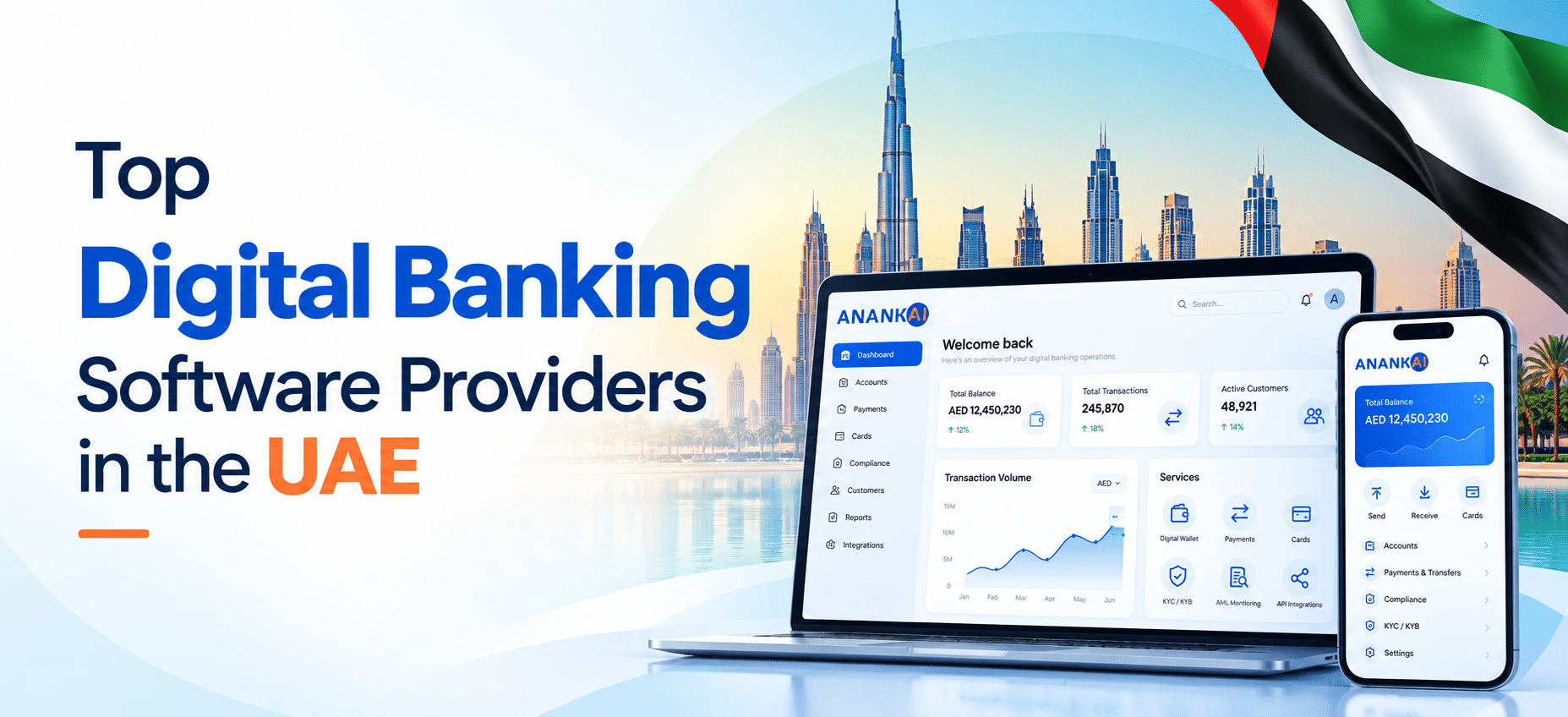
Top Digital Banking Software Providers in the UAE
The UAE’s digital banking market is creating demand for modern, API-driven banking technology that can support digital onboarding, payments, accounts, cards and compliance.
This guide covers leading digital banking software providers and the key requirements UAE financial institutions should consider when evaluating them.
Top Digital Banking Software Providers in the UAE
1. AnankAI
AnankAI provides a modular, API-first digital banking and fintech technology platform for banks, EMIs, PSPs, neobanks and fintech companies. Its capabilities include digital wallets, multi-currency accounts, digital onboarding, KYC/KYB, AML and transaction monitoring, payments and transfers, card management, reporting and API integrations.
Its modular approach allows organisations to select the capabilities they need instead of developing every component internally. This can be relevant for UAE fintechs and financial institutions looking to connect banking, payments and compliance functions through a single technology layer.
2. Temenos
Temenos provides banking technology covering core banking, digital banking, payments and other financial services capabilities. Its platform is designed for financial institutions that need to modernise banking operations while supporting digital customer journeys.
For UAE institutions, Temenos can be considered where a broad banking technology environment and established enterprise capabilities are required.
3. Mambu
Mambu provides a cloud-native core banking platform built around composable banking architecture. Its UAE relevance is particularly visible through Wio Bank, which used Mambu’s technology as part of its digital banking platform. Wio Bank launched in Abu Dhabi in 2022 and used Mambu’s cloud-native core to support its digital banking model.
Mambu is therefore relevant for organisations considering a cloud-native approach to launching or modernising banking services.
4. Oracle FLEXCUBE
Oracle FLEXCUBE is an enterprise banking platform supporting core banking and related financial services operations. Oracle has documented its use by UAE institutions, including Mashreq, which uses Oracle FLEXCUBE Universal Banking alongside other Oracle financial services technologies.
It is suited to organisations with complex banking operations and requirements extending beyond customer-facing digital channels into core banking infrastructure.
5. Infosys Finacle
Infosys Finacle provides core banking and digital engagement technology for financial institutions. Its UAE presence includes RAKBANK, which has used Finacle’s digital engagement capabilities as part of its digital-first banking strategy. Finacle has also supported digital onboarding and customer journeys involving UAE identity information such as Emirates ID.
For banks modernising digital channels while maintaining connections to core banking operations, Finacle is another platform worth evaluating.
How to Evaluate Digital Banking Software Providers
Architecture and integration: Look for API capabilities, event-driven connectivity and integration options for existing core systems, payment providers, KYC/KYB services, card processors and other third-party platforms.
Banking functionality: Evaluate whether the platform supports the required capabilities across accounts, wallets, payments, cards, customer onboarding, transaction management and reporting. A platform should also allow additional modules to be introduced as requirements evolve.
Compliance and risk: KYC, KYB, AML, sanctions screening, transaction monitoring, audit trails and role-based controls should be considered at the architecture level rather than added as separate afterthoughts.
Scalability: Assess how the platform handles increasing customers, accounts and transaction volumes. Cloud deployment, infrastructure flexibility and operational resilience are particularly important for digital-first institutions.
Implementation and migration: For an existing bank, migration complexity can be as important as product functionality. Data migration, reconciliation, integration testing, security testing and cutover planning need to be assessed before selecting a platform. Oracle’s documented Mashreq implementation in the UAE, for example, involved multiple rounds of data migration and financial reconciliation.
UAE Requirements for Banking Software
- Digital banking software used by UAE financial institutions needs to operate within a regulated financial environment. The Central Bank of the UAE (CBUAE) regulates areas including retail payment services, digital money and payment systems. Payment service providers are subject to licensing and ongoing regulatory requirements.
- AML/CFT capabilities are particularly important. Under the CBUAE’s Retail Payment Services and Card Schemes Regulation, payment service providers must address money laundering and terrorist financing risks, conduct relevant risk assessments and report suspicious transactions to the UAE Financial Intelligence Unit where required.
- Open Finance is another important technology consideration. The CBUAE’s Open Finance Framework includes an API Hub, Trust Framework and common infrastructure for consent-based data sharing and transaction initiation. The framework therefore makes secure API architecture, identity and access management and consent handling increasingly relevant to banking technology.
- The CBUAE has also published regulatory guidance covering the adoption of technologies such as APIs, cloud computing, artificial intelligence, biometrics, big data analytics and distributed ledger technology.
Conclusion
Choosing the right digital banking software in the UAE depends on your business needs, required capabilities, integrations and regulatory requirements. The right platform should support your current operations while giving you the flexibility to scale as your digital banking services grow.
For more details, contact us.