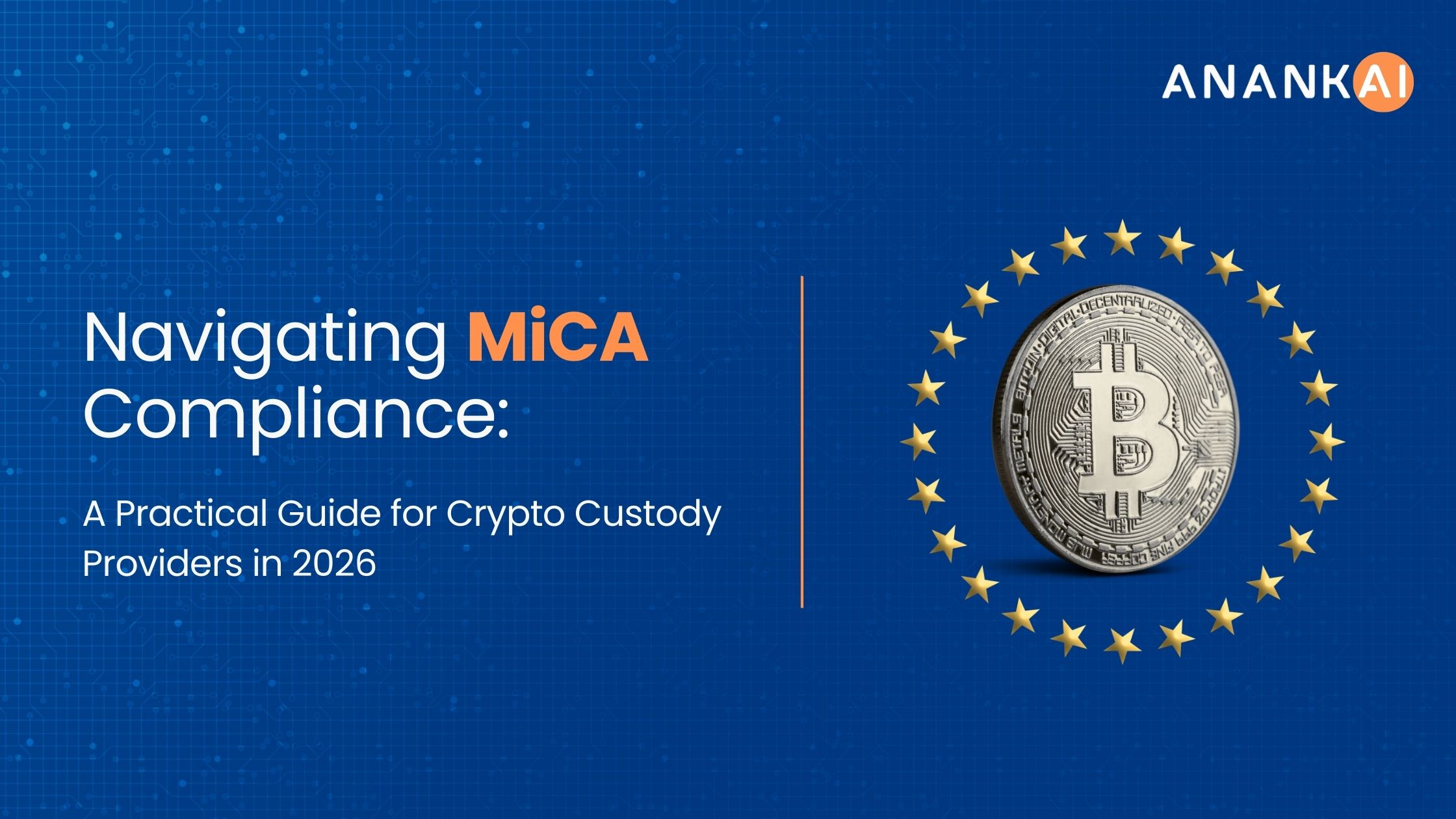
Navigating MiCA Compliance:
A Practical Guide for Crypto Custody Providers in 2026
MiCA Compliance Guide 2026
The Markets in Crypto-Assets (MiCA) Regulation is the European Union’s first comprehensive regulatory framework for crypto-assets and crypto-asset service providers (CASPs). Designed to create a unified legal framework across EU member states, MiCA aims to improve consumer protection, market integrity, and financial stability while encouraging responsible innovation.
For crypto exchanges, wallet providers, stablecoin issuers, fintech companies, and digital asset businesses operating in Europe, MiCA is no longer optional; it is becoming a fundamental requirement.
This guide explains what MiCA is, who it applies to, the major compliance obligations, and how technology can help organisations build efficient, scalable compliance operations.
Table of Contents
- What is MiCA?
- Why Was MiCA Introduced?
- Who Must Comply with MiCA?
- Key Objectives of MiCA
- MiCA Timeline
- Major Compliance Requirements
- Technology Challenges Under MiCA
- How Technology Supports MiCA Compliance
- Best Practices for MiCA Readiness
- Frequently Asked Questions
- Conclusion
What Is MiCA?
The Markets in Crypto-Assets (MiCA) Regulation establishes a harmonised legal framework for crypto-assets across the European Union.
Before MiCA, crypto regulations varied significantly between member states, making it difficult for businesses to operate across borders. MiCA introduces consistent rules that simplify market access while strengthening oversight and protecting consumers.
The regulation covers several categories of crypto-assets and establishes requirements for businesses offering crypto-related products and services throughout the EU.
Why Was MiCA Introduced?
The rapid growth of the crypto industry created regulatory gaps that increased risks for consumers and financial markets.
MiCA was introduced to:
- Create a single regulatory framework across the EU
- Increase consumer protection
- Improve transparency
- Reduce financial crime risks
- Encourage innovation within clear regulatory boundaries
- Support cross-border crypto services
By creating common standards, MiCA aims to make Europe’s crypto market safer and more predictable for both businesses and customers.
Who Must Comply with MiCA?
MiCA applies to many organisations involved in crypto-assets, including:
- Crypto exchanges
- Crypto wallet providers
- Stablecoin issuers
- Crypto payment providers
- Digital asset custodians
- Token issuers
- Crypto brokers
- FinTech companies providing crypto services
- Crypto-asset service providers (CASPs)
If your business provides crypto-related financial services within the European Union, MiCA may apply to your operations.
Understanding MiCA Requirements for Crypto Custody Services
For organisations providing crypto custody services, MiCA introduces additional operational expectations designed to strengthen customer protection and improve market integrity.
Authorisation and Governance
Crypto custody providers must obtain the appropriate authorisation under the MiCA framework and demonstrate effective governance arrangements, internal controls, and operational oversight. Organisations are expected to establish clear responsibilities, risk management procedures, and compliance frameworks that support ongoing regulatory obligations.
Safeguarding Customer Assets
One of MiCA’s key objectives is protecting customer assets. Custody providers should implement appropriate safeguarding measures, including secure key management practices, asset segregation where applicable, cybersecurity controls, and robust operational security designed to reduce the risk of unauthorised access or loss.
Operational Resilience
MiCA places significant emphasis on operational resilience. Organisations should maintain:
- Business continuity plans
- Disaster recovery procedures
- Incident response frameworks
- Regular security assessments
- Ongoing infrastructure monitoring
Building resilient operational processes helps organisations respond effectively to disruptions while maintaining customer trust.
Key Objectives of MiCA
MiCA focuses on five primary objectives:
Consumer Protection
Businesses must provide clear information about crypto-assets, associated risks, and customer rights.
Market Integrity
The regulation introduces measures to reduce insider trading, market manipulation, and unfair trading practices.
Financial Stability
Stablecoin issuers must meet stricter requirements to minimise systemic financial risks.
Operational Resilience
Organisations must maintain secure systems, governance processes, and operational controls.
Innovation
Rather than restricting innovation, MiCA provides regulatory clarity that supports long-term growth across the European crypto ecosystem.
MiCA Timeline
The implementation of MiCA has been phased to allow businesses time to prepare.
Key milestones include:
- Adoption by the European Parliament
- Publication in the Official Journal of the European Union
- Stablecoin-related provisions entering into force
- Full implementation for Crypto-Asset Service Providers (CASPs)
Businesses should monitor updates from their national competent authority to ensure compliance with applicable timelines.
Major MiCA Compliance Requirements
Licensing Requirements
Crypto-Asset Service Providers (CASPs) must obtain the appropriate authorisation before offering regulated services within the European Union.
Governance Requirements
Businesses should establish:
- Internal governance policies
- Risk management frameworks
- Compliance controls
- Operational procedures
- Incident management processes
Customer Protection
MiCA requires organisations to:
- Provide transparent disclosures
- Protect customer assets
- Manage complaints effectively
- Ensure fair treatment of customers
Operational Resilience
Businesses should maintain:
- Secure infrastructure
- Business continuity plans
- Cybersecurity controls
- Disaster recovery procedures
MiCA, AML and the Travel Rule
MiCA operates alongside other European and international regulatory frameworks rather than replacing them.
Organisations offering crypto-related financial services should also consider obligations under:
- EU Anti-Money Laundering legislation (AMLD)
- The Transfer of Funds Regulation (TFR)
- FATF Recommendations, including the Travel Rule
- Local supervisory guidance
Together, these frameworks require organisations to establish effective controls for customer due diligence, sanctions screening, transaction monitoring, and regulatory reporting.
AML and Financial Crime Controls
Although MiCA itself is not an AML regulation, organisations must work alongside applicable AML and counter-terrorist financing requirements.
This often involves:
- Customer due diligence (KYC)
- Business verification (KYB)
- Sanctions screening
- Transaction monitoring
- Ongoing customer risk assessments
- Suspicious activity reporting
Technology Challenges Under MiCA
Many organisations discover that regulatory requirements cannot be managed effectively through manual processes alone.
Common challenges include:
- Scaling customer onboarding
- Managing increasing transaction volumes
- Monitoring suspicious activities in real time
- Maintaining audit trails
- Integrating multiple compliance systems
- Managing regulatory reporting
- Reducing false positives
- Improving operational efficiency
As businesses grow, these challenges become increasingly difficult without dedicated compliance technology.
Meeting these regulatory expectations often requires organisations to address several operational challenges, including:
- Real-time customer verification
- Secure data exchange between counterparties
- Transaction monitoring across multiple digital assets
- Audit trail management
- Regulatory reporting
- Cross-border compliance processes
- Managing increasing transaction volumes while reducing false positives
As crypto businesses grow, manual compliance processes become increasingly difficult to scale efficiently.
Building a MiCA-Ready Technology Stack
Many organisations are adopting integrated compliance technology to support their operational requirements.
A modern technology stack may include:
API-Driven Integrations
API-based integrations enable organisations to connect customer onboarding, identity verification, transaction monitoring, sanctions screening, and reporting into a unified workflow.
Digital Identity Verification
Integrated KYC and KYB solutions help automate customer onboarding while supporting ongoing due diligence and risk assessment.
Transaction Monitoring
Real-time transaction monitoring enables organisations to detect unusual activity, apply configurable risk rules, generate alerts, and support investigation workflows.
Compliance Workflow Automation
Automation can reduce manual effort through:
- Case management
- Risk scoring
- Document management
- Audit logging
- Regulatory reporting support
- Workflow approvals
Security and Access Controls
Strong operational security includes:
- Role-based access controls
- Multi-factor authentication
- Secure API communication
- Encryption
- Comprehensive audit logs
- Infrastructure monitoring
Practical MiCA Implementation Framework
A structured implementation approach can help organisations prepare for evolving regulatory expectations.
1. Assess Current Processes
Review existing compliance workflows, governance arrangements, and operational controls against applicable regulatory requirements.
2. Modernise Technology
Identify opportunities to automate customer onboarding, transaction monitoring, reporting, and compliance operations through scalable technology.
3. Document Policies
Maintain clear internal policies covering governance, customer due diligence, transaction monitoring, incident response, and operational resilience.
4. Train Teams
Ensure compliance, operations, and technology teams understand both regulatory expectations and internal processes.
5. Monitor Regulatory Developments
MiCA continues to evolve through technical standards and supervisory guidance. Organisations should regularly review updates from relevant regulatory authorities and adapt their processes accordingly.
How Technology Supports MiCA Compliance
Technology plays an essential role in helping organisations implement operational processes that support regulatory obligations.
Modern compliance platforms can help organisations:
Digital Customer Onboarding
- KYC verification workflows
- KYB verification
- Identity validation
- Risk scoring
Transaction Monitoring
- Real-time monitoring
- Rule-based detection
- Automated alerts
- Case management workflows
Compliance Operations
- Customer risk profiling
- Audit logs
- Workflow automation
- Document management
Reporting
- Regulatory reporting support
- Investigation records
- Activity logs
- Compliance dashboards
Implementing integrated technology can improve operational efficiency while supporting consistent compliance processes across growing businesses.
Best Practices for MiCA Readiness
Organisations preparing for MiCA should consider the following best practices:
- Understand applicable regulatory requirements
- Review existing compliance processes
- Strengthen governance frameworks
- Implement scalable technology
- Improve transaction monitoring capabilities
- Automate customer onboarding where appropriate
- Maintain detailed audit records
- Conduct regular internal compliance reviews
- Train compliance teams continuously
- Monitor regulatory updates across EU jurisdictions
Frequently Asked Questions
What is MiCA?
MiCA (Markets in Crypto-Assets Regulation) is the European Union’s regulatory framework governing crypto-assets and crypto-asset service providers.
Who needs to comply with MiCA?
Crypto exchanges, wallet providers, custodians, token issuers, stablecoin issuers, and other crypto-asset service providers operating within the EU may be subject to MiCA requirements.
Is MiCA an AML regulation?
No. MiCA focuses on crypto-assets, while AML obligations continue under separate anti-money laundering legislation. Businesses typically need to comply with both.
What is a CASP?
A Crypto-Asset Service Provider (CASP) is an organisation providing regulated crypto services such as custody, exchange, trading, transfers, or portfolio management.
Can technology help support MiCA compliance?
Technology can streamline operational activities such as customer onboarding, transaction monitoring, workflow automation, audit logging, and compliance reporting. However, businesses remain responsible for meeting their regulatory obligations and should seek appropriate legal or compliance advice where required.
Conclusion
MiCA marks a significant step towards a more structured and transparent crypto market across Europe. While the regulation introduces new operational responsibilities, it also creates opportunities for businesses to scale confidently within a harmonised regulatory framework.
Preparing early by strengthening governance, improving operational processes, and implementing scalable compliance technology can help organisations adapt more efficiently as regulatory expectations evolve.
How AnankAI Supports Compliance Operations
AnankAI provides technology infrastructure designed to help fintechs, payment institutions, and digital asset businesses streamline customer onboarding, automate compliance workflows, strengthen transaction monitoring, and improve operational efficiency.
Our platform includes capabilities such as:
- Digital KYC and KYB workflows
- AML transaction monitoring
- Case management
- Risk scoring
- Workflow automation
- Compliance dashboards
- API-based integrations
AnankAI is a technology provider and does not provide legal advice, regulatory approvals, or licensing services. Organisations should consult qualified legal and compliance professionals regarding their specific regulatory obligations.
Ready to modernise your compliance operations?
Contact AnankAI to explore how our compliance technology platform can support your digital finance infrastructure.
Relevant Articles…
What is Compliance and Risk Management: Key Differences

Choosing the Right Digital Wallet Platform for European FinTechs

I am actually pleased to read this webpage posts which consists of plenty of valuable information, thanks for providing such statistics.