
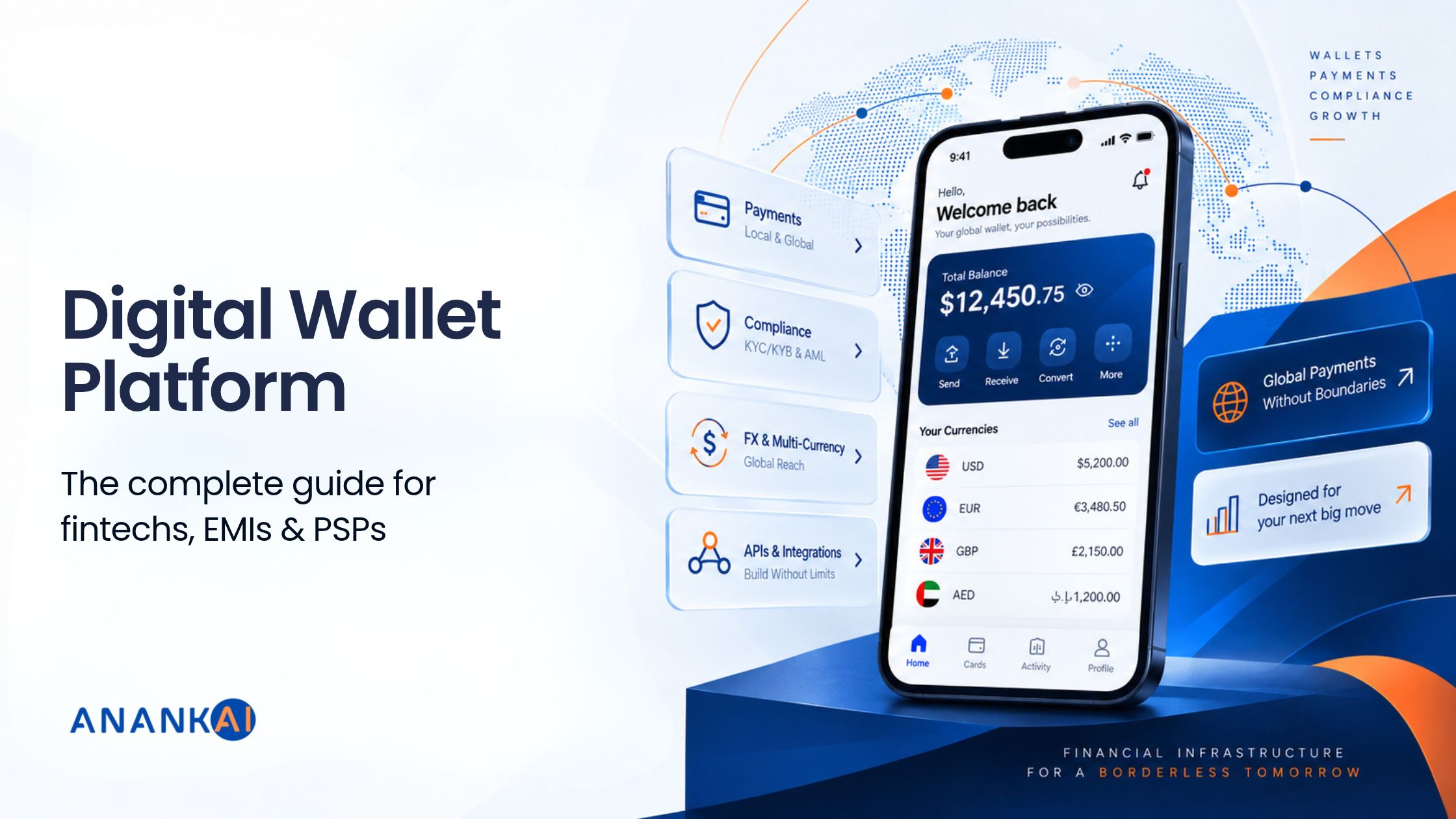
Digital wallets have evolved from simple payment applications into sophisticated financial infrastructure.
Today, FinTechs, Electronic Money Institutions (EMIs), Payment Institutions (PIs), Payment Service Providers (PSPs), neobanks and businesses adopting embedded finance use digital wallets to provide customers with ways to hold funds, make payments, receive money and manage multiple currencies.
But launching a digital wallet is not simply a matter of developing a mobile application.
Behind the customer-facing experience is a technology stack involving wallet accounts, ledgers, payment processing, APIs, integrations, KYC/KYB, AML monitoring, transaction management, security, reconciliation and reporting.
For financial businesses, the key question is therefore not simply “How do we build a wallet?”
It is:
How do we build or deploy digital wallet infrastructure that can scale across customers, currencies, payment methods and markets?
This guide explains the key components of a modern digital wallet platform, how the underlying architecture works, and what FinTechs, EMIs and PSPs should evaluate when selecting wallet infrastructure.
What Is a Digital Wallet Platform?
A digital wallet platform is the underlying technology infrastructure used to create, manage and operate digital wallets.
A wallet platform can provide the technology required to:
- Create customer wallet accounts
- Manage balances
- Hold multiple currencies
- Send and receive funds
- Process payments
- Connect to payment providers
- Integrate KYC and KYB verification
- Monitor transactions
- Manage compliance workflows
- Reconcile transactions
- Generate operational reports
The customer may interact with the wallet through a mobile or web application, while the platform manages the underlying financial workflows.
A modern digital wallet platform can therefore act as the technology layer between the customer experience, payment infrastructure and financial operations.
How Does a Digital Wallet Platform Work?
A typical wallet architecture connects several technology layers.
Customer Application
↓
Authentication & Customer Management
↓
Wallet & Account Engine
↓
Ledger
↓
Payment Processing
↓
Payment Rails / Banking Partners
↓
Settlement & Reconciliation
Alongside these components are supporting services such as:
- KYC/KYB
- AML monitoring
- Fraud controls
- Notifications
- Reporting
- Analytics
- API integrations
This connected architecture allows customer, payment and operational information to move between different parts of the platform.
Key Components of a Digital Wallet Platform
1. Wallet and Account Management
The wallet engine manages customer accounts and balances.
Depending on the business model, a platform may support:
- Individual accounts
- Business accounts
- Corporate accounts
- Sub-accounts
- Hierarchical account structures
- Multi-currency accounts
- Wallet-to-wallet transfers
For a growing FinTech, the account architecture should be capable of supporting increasing numbers of customers without requiring a complete rebuild.
2. Digital Wallet Ledger
The ledger is one of the most important components of wallet infrastructure.
Every movement of funds needs to be recorded accurately.
A robust wallet ledger should support:
- Debit and credit entries
- Available balances
- Pending balances
- Transaction states
- Fees
- Refunds
- Reversals
- Adjustments
- Currency conversions
- Complete transaction history
A well-designed ledger also makes reconciliation and financial reporting easier.
Why the Ledger Matters
A wallet may appear simple from the customer’s perspective:
“My balance is £5,000.”
Behind that balance, however, the platform may need to account for:
- Incoming payments
- Outgoing payments
- Pending transactions
- Fees
- Currency conversions
- Reversals
- Settlement transactions
As transaction volumes increase, a reliable ledger becomes essential.
3. Multi-Currency Wallets
Many modern financial products need to support customers across multiple markets.
A multi-currency wallet allows users to hold and manage different currencies within one financial environment.
For example:
USD
EUR
GBP
AED
INR
The platform needs to maintain accurate balances for each currency while also supporting transfers and conversions between them.
Multi-currency infrastructure is particularly relevant for:
- International businesses
- Cross-border payment providers
- Remittance companies
- Global marketplaces
- Neobanks
- PSPs
- FinTech platforms
AnankAI’s platform currently positions multi-currency wallets alongside payment processing, KYC/KYB and other fintech infrastructure capabilities.
4. Payment Processing
A digital wallet becomes significantly more useful when it can connect to payment infrastructure.
Depending on the product, payment functionality may include:
- Bank transfers
- Wallet-to-wallet transfers
- P2P payments
- Customer payouts
- Merchant payments
- Account funding
- Domestic payments
- Cross-border payments
The payment engine manages the movement of funds between the wallet and external financial infrastructure.
5. Payment Rails and Integrations
No single payment rail covers every country, currency and transaction type.
A wallet platform may therefore need to integrate with:
- SEPA
- SWIFT
- Faster Payments
- Local payment networks
- Banking providers
- Card networks
- Payment processors
An API-first architecture makes it easier to connect additional providers as the business expands.
AnankAI’s current platform positioning includes SEPA/SWIFT, Faster Payments, APIs and multi-currency capabilities.
6. KYC and KYB Onboarding
Customer onboarding is an important part of a digital wallet platform.
Depending on the customer type, the onboarding journey may include:
Individual customers
- Identity verification
- Personal information
- Address verification
- Sanctions screening
- Customer risk assessment
Business customers
- Business verification
- Company information
- Directors
- Beneficial owners
- Business risk assessment
A connected onboarding workflow can reduce manual processes while creating a consistent customer journey.
AnankAI provides technology and integrations for KYC/KYB workflows rather than acting as the regulated financial institution or providing regulatory authorisation.
7. AML and Transaction Monitoring
Wallet platforms process financial transactions, making transaction monitoring an important component of the technology environment.
Depending on the business model and applicable requirements, monitoring capabilities can include:
- Transaction monitoring
- Sanctions screening
- Customer risk assessment
- Alert generation
- Case management
- Investigation workflows
- Audit trails
The objective is to connect transaction activity with customer and risk information so relevant teams can investigate activity through a structured workflow.
8. Digital Wallet APIs
APIs allow the wallet platform to connect with external applications and services.
Common APIs may include:
Wallet APIs
- Create wallet
- Retrieve wallet
- Retrieve balance
- View transaction history
Payment APIs
- Initiate payment
- Transfer funds
- Check payment status
- Create beneficiary
FX APIs
- Retrieve exchange rate
- Request quotation
- Execute conversion
Compliance APIs
- KYC verification
- KYB verification
- Screening
- Risk information
Webhooks
Webhooks can provide real-time updates when events occur.
For example:
Payment initiated
→ Processing
→ Completed
or
Payment initiated
→ Processing
→ Failed
This is particularly important for applications that need real-time payment status.
9. Security and Fraud Controls
A digital wallet platform handles sensitive financial and customer information.
Security should therefore be considered throughout the architecture.
Important areas include:
- Authentication
- Multi-factor authentication
- Encryption
- Role-based access
- API security
- Session management
- Transaction controls
- Audit logs
- Fraud monitoring
Depending on the product, additional controls may include transaction limits, velocity monitoring and behavioural risk analysis.
10. Card and Wallet Integration
Many digital wallet products are connected to virtual or physical payment cards.
A wallet platform may support:
- Virtual cards
- Physical cards
- Prepaid cards
- Debit cards
- Card controls
- Card-to-wallet relationships
- Wallet funding
The important architectural consideration is that card activity should connect correctly with the wallet and ledger.
A customer paying with a card should have the corresponding financial movement reflected accurately in the underlying account and transaction records.
11. FX and Currency Conversion
Multi-currency wallets often require foreign exchange functionality.
A typical FX workflow can include:
- Customer requests a conversion.
- Platform retrieves an exchange rate.
- Applicable pricing or margin is calculated.
- Rate is confirmed or locked.
- Conversion is executed.
- Ledger records the currency movements.
- Balances are updated.
- Transaction is reconciled.
For businesses processing significant cross-border volumes, FX architecture can become an important part of the overall payment infrastructure.
12. Settlement and Reconciliation
Payment providers and banking partners may settle transactions at different times and through different processes.
This creates reconciliation challenges.
A wallet platform should ideally support:
- Automated transaction matching
- Settlement tracking
- Exception management
- Payment status monitoring
- Fee reconciliation
- Ledger reconciliation
- Operational reporting
When transactions cannot be matched automatically, they should enter an exception workflow so operations teams can investigate and resolve the issue.
Digital Wallet Architecture: Build for Scale
A scalable wallet platform should not be designed only around today’s transaction volume.
Technology teams should consider future requirements such as:
- Additional currencies
- New payment rails
- More customers
- Additional markets
- New financial products
- Higher transaction volumes
- New banking partners
- Additional KYC/KYB providers
A modular architecture makes these changes easier to manage.
Instead of rebuilding the entire platform, businesses can add or modify individual capabilities.
Build vs Buy a Digital Wallet Platform
One of the biggest decisions for a FinTech is whether to build wallet infrastructure internally or use an existing platform.
Building From Scratch
Advantages can include:
- Maximum control
- Deep customisation
- Full ownership of the technology stack
However, it can require significant:
- Engineering resources
- Development time
- Infrastructure investment
- Integration work
- Ongoing maintenance
Using a Digital Wallet Platform
A ready-built platform can provide existing infrastructure for:
- Wallets
- Accounts
- Payments
- APIs
- Onboarding
- Compliance workflows
- Reporting
- Integrations
This can allow a fintech’s engineering team to focus more heavily on its differentiating product and customer experience.
The appropriate approach depends on the organisation’s requirements, resources, architecture and long-term strategy.
White-Label Digital Wallet Platforms
A white-label wallet platform allows a business to launch a wallet under its own brand while using an underlying technology platform.
This can include customisation of:
- Brand identity
- Logo
- Colours
- User interface
- Customer journeys
- Wallet features
- Mobile application
White-label infrastructure can be particularly useful for fintech startups and businesses looking to launch financial products without developing every infrastructure component internally.
AnankAI currently offers a white-label digital wallet solution positioned for FinTechs, EMIs, PSPs and banks, with capabilities including multi-currency wallets, payments, cards, KYC/KYB, AML monitoring and third-party integrations.
Digital Wallet Platform for EMIs and PSPs
For EMIs and PSPs, wallet infrastructure needs to support more than customer-facing functionality.
The platform should also provide operational capabilities across:
- Customer accounts
- Wallet management
- Payment processing
- KYC/KYB
- Transaction monitoring
- Payment integrations
- Reconciliation
- Reporting
- Audit trails
This is where an integrated platform can be valuable.
Instead of managing completely separate systems for wallets, onboarding, payments and monitoring, businesses can connect these capabilities through a common technology layer.
How to Choose a Digital Wallet Platform
Before selecting a platform, technology and business teams should evaluate several areas.
Technology
- API-first architecture
- Modular design
- Scalability
- Cloud infrastructure
- Integration capabilities
Wallet
- Single-currency support
- Multi-currency support
- Customer accounts
- Business accounts
- Wallet-to-wallet transfers
Payments
- Domestic payments
- Cross-border payments
- Payment rails
- Banking integrations
- Card integrations
Compliance workflows
- KYC
- KYB
- AML monitoring
- Sanctions screening
- Case management
Operations
- Reconciliation
- Settlement
- Reporting
- Audit trails
- Operational dashboards
Security
- Authentication
- Access controls
- Encryption
- API security
- Monitoring
Scalability
- Additional currencies
- Additional markets
- Additional providers
- Higher transaction volumes
- New financial products
Why AnankAI for Digital Wallet Infrastructure?
AnankAI provides technology infrastructure for businesses building modern financial products.
Its platform brings together capabilities across:
- Digital wallets
- Multi-currency accounts
- Payment processing
- KYC/KYB onboarding
- AML transaction monitoring
- Card management
- Payment APIs
- Financial operations
- Reporting and analytics
The platform is designed to be modular, allowing businesses to select the capabilities relevant to their product and expand their technology stack as requirements evolve.
AnankAI also supports white-label wallet experiences, allowing businesses to maintain their own brand and customer experience while using AnankAI as the underlying technology layer.
Importantly, AnankAI is a technology and software infrastructure provider. It does not provide EMI, banking or payment licences, regulatory approvals or licence acquisition services. The relevant financial institution remains responsible for its regulatory obligations and compliance decisions.
Digital Wallet Platform: The Future of FinTech Infrastructure
Digital wallets are becoming increasingly connected to broader financial infrastructure.
Future wallet platforms will increasingly combine:
- Multi-currency accounts
- Real-time payments
- Card programmes
- Embedded finance
- Cross-border payments
- Digital identity
- Automated compliance workflows
- Advanced fraud controls
- API-driven financial services
The wallet itself is therefore becoming less of an isolated product and more of a financial infrastructure layer.
For FinTechs, EMIs, PIs and PSPs, choosing the right wallet technology can influence how quickly products can launch, how easily new markets can be entered and how effectively the platform can scale.
Conclusion
A modern digital wallet platform is much more than a mobile application.
It is a technology infrastructure layer connecting customers, accounts, ledgers, payments, currencies, APIs, compliance workflows, cards and financial operations.
For businesses building digital financial products, the key is to select infrastructure that can support today’s requirements while providing a foundation for future growth.
Whether the goal is to launch a multi-currency wallet, build a payment product, create a white-label financial service or expand an existing fintech platform, the underlying architecture needs to be secure, scalable, modular and integration-ready.
AnankAI provides the technology infrastructure to help FinTechs, EMIs, PIs, PSPs, neobanks and digital financial businesses build and scale digital wallet and payment products.
Explore AnankAI’s Digital Wallet Platform →
AnankAI Digital Wallet Platform
Recent Articles
What is Compliance and Risk Management: Key Differences

Choosing the Right Digital Wallet Platform for European FinTechs
