
Card Management System vs Card Processor: Key Differences for Banks and Fintechs
If you’re planning to launch or modernise a debit or credit card programme, you’ve likely come across two important terms: Card Management System (CMS) and card processor.
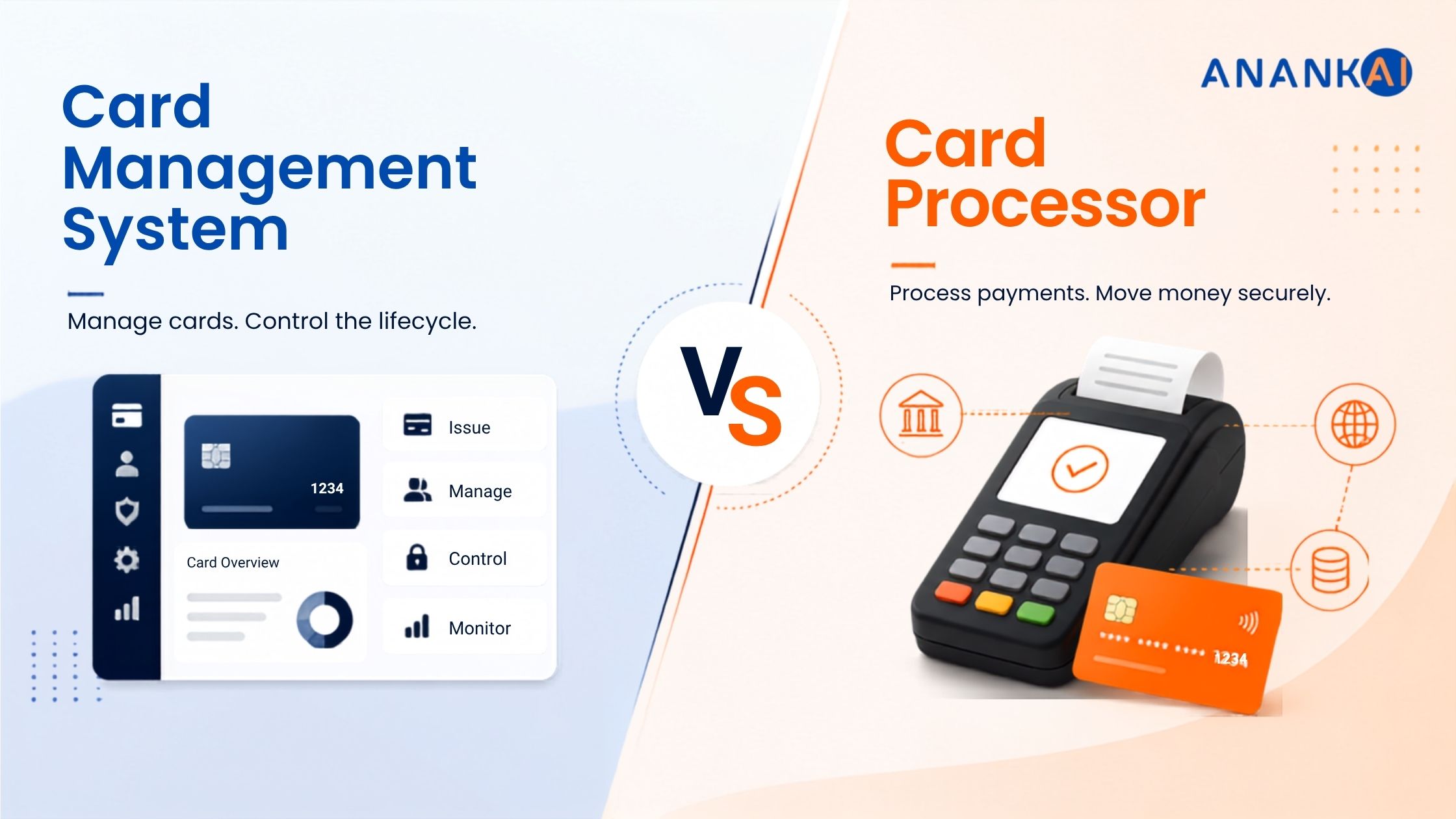
Although they are closely connected, they serve different purposes within a card issuing ecosystem. A Card Management System manages the business, financial and operational aspects of a card programme, while a card processor handles the real-time processing and connectivity required to authorise and settle card transactions.
So, do banks, fintechs and payment institutions need both?
In most card programme architectures, yes. The two systems work together to provide the infrastructure required to operate a complete card programme.
This guide explains the difference between a Card Management System and a card processor, how they interact, and why financial institutions need both to operate scalable debit and credit card programmes.
What Is a Card Management System (CMS)?
A Card Management System (CMS) is a technology platform used by banks, fintechs and financial institutions to manage the operational and financial lifecycle of card programmes.
While a processor focuses primarily on moving card transactions through the payment network, a Card Management System manages the customer, account, card and financial processes surrounding those transactions.
A modern Card Management System can support:
Customer onboarding and KYC/KYB workflows
Customer profile and account management
Card and account lifecycle management
Credit limit and exposure management
Multi-ledger accounting
Interest and fee calculation
Billing and statement generation
Payment allocation and reconciliation
Delinquency and collections management
Customer servicing
Regulatory reporting and audit trails
Portfolio analytics and reporting
Card Lifecycle Management
A comprehensive CMS can also manage the card lifecycle from issuance through replacement, renewal and closure.
Typical capabilities include:
Card activation
Card status management
Card replacement and renewal
Spending controls
Transaction visibility
Token management
Digital wallet integration
Card-level controls and configuration
This allows financial institutions to manage debit and credit card programmes through a centralised platform rather than relying on multiple disconnected systems.
What Does a Card Processor Do?
A card processor provides the infrastructure required to process card transactions between the cardholder, merchant, issuer and payment network.
When a customer uses a card to make a payment, the processor helps route and process the transaction, including the authorisation and settlement stages.
Depending on the processor and programme architecture, processor capabilities may include:
Transaction authorisation
Payment network connectivity
Transaction routing
Clearing and settlement
Fraud and transaction rule execution
Chargeback processing
Card scheme connectivity and compliance
Network tokenisation
Card provisioning and related processing services
Card processors connect into payment networks and card schemes such as Visa and Mastercard, enabling card transactions to be processed between merchants and issuing institutions.
Card Management System vs Card Processor
The simplest way to understand the difference is to look at what each system is responsible for.
| Card Management System | Card Processor |
|---|---|
| Customer onboarding | Transaction processing |
| Customer and account management | Payment network connectivity |
| Card lifecycle management | Transaction authorisation |
| Credit limit and exposure management | Transaction routing |
| Billing and statements | Clearing and settlement |
| Interest and fee calculations | Fraud and transaction rules |
| Payment allocation | Chargeback processing |
| Collections and recovery | Scheme connectivity |
| Regulatory reporting | Network tokenisation |
| Portfolio analytics | Processing infrastructure |
In simple terms:
The Card Management System manages the card programme. The processor processes the card transactions.
How Do a Card Management System and Card Processor Work Together?
A modern card programme typically requires several technology layers working together.
For example:
Customer
↓
Card Management System
Customer, account, card, limits, billing, ledger, payments and servicing
↓
Card Processor
Authorisation, transaction processing and network connectivity
↓
Card Scheme / Payment Network
Visa, Mastercard or another applicable network
↓
Merchant
This separation allows a financial institution to select the technology that best fits each part of its card programme.
For example, an institution can use a Card Management System to manage customer accounts, billing, credit and financial operations while connecting it to its preferred card processor for transaction processing.
Why Do Banks and Fintechs Need Both?
One of the most common questions is:
Can a card processor replace a Card Management System?
Generally, no.
A processor is primarily responsible for processing transactions and providing payment-network connectivity. It does not necessarily provide the complete set of capabilities required to manage customers, accounts, financial products and card-programme operations.
A complete card programme may also require:
Customer onboarding
Account management
Card lifecycle management
Credit and risk management
Ledger and accounting capabilities
Billing and repayment management
Interest and fee calculations
Collections
Customer servicing
Regulatory reporting
Portfolio analytics
These functions are where a Card Management System becomes critical.
The exact division of responsibilities varies by architecture and provider, but the key distinction remains:
Processing transactions is not the same as managing the card programme.
AnankAI Card Management Platform
AnankAI provides a comprehensive Card Management Platform for banks, fintechs, payment institutions and other financial businesses.
The platform is designed to manage the business and operational layers of debit and credit card programmes while integrating with the card-processing infrastructure required to execute transactions.
Rather than requiring institutions to replace their existing processor, AnankAI can integrate with established processing infrastructure, allowing organisations to retain their preferred processing partner while centralising their card-programme management capabilities.
Key capabilities include:
Customer onboarding and KYC/KYB workflows
Customer profile and account management
Card lifecycle management
Credit limit and exposure management
Multi-ledger accounting
Balance management
Interest and fee calculation
Billing and statement generation
Payment processing and allocation
Collections and recovery management
Regulatory reporting
Portfolio analytics and reporting
The platform can also support card lifecycle operations such as:
Card activation
Card controls
Card replacement
Card renewal
Transaction visibility
Token management
Digital wallet integration
Benefits of a Modern Card Management Platform
When evaluating a Card Management System, banks and fintechs should look beyond basic card administration.
A modern platform should provide the flexibility required to operate and scale an entire card programme.
Key considerations include:
1. End-to-End Card Lifecycle Management
Manage cards from issuance and activation through replacement, renewal and closure.
2. Debit and Credit Card Support
Support multiple card products and programme configurations through a unified platform.
3. Processor Integration
Connect the Card Management System with existing or preferred card-processing infrastructure.
4. Automated Billing and Payments
Automate billing, statements, repayments, payment allocation and reconciliation.
5. Financial and Ledger Management
Maintain accurate balances, transactions, fees, interest and accounting records across card programmes.
6. Compliance and Auditability
Support regulatory reporting, operational controls and auditable workflows.
7. Portfolio Visibility
Provide analytics and reporting across customers, accounts, cards, transactions and portfolio performance.
8. Scalable Architecture
Build a technology foundation that can support increasing customers, transaction volumes, card products and new payment capabilities.
Card Management System vs Card Processor: Which One Do You Need?
The answer depends on your card programme architecture.
If you already have a card processor but need a platform to manage customers, accounts, cards, billing, credit, payments, accounting and programme operations, a Card Management System can provide the missing management layer.
If you are building a new card programme, you may need both:
Card Management System + Card Processor + Card Scheme/Network Connectivity
The important consideration is not choosing one over the other. It is ensuring that the different components of your card infrastructure integrate effectively.
Why Choose AnankAI?
AnankAI’s Card Management Platform helps financial institutions centralise the operational and financial management of their card programmes while integrating with the wider payment ecosystem.
This enables banks, fintechs and payment institutions to build a technology architecture that is:
Scalable
Integration-ready
Operationally efficient
Data-driven
Designed for modern card programmes
Whether you’re launching a new debit card programme, expanding an existing credit card portfolio or modernising legacy card infrastructure, AnankAI can provide the Card Management layer required to support your programme.
Ready to modernise your card infrastructure?
Contact the AnankAI team to discuss your card management requirements.
Frequently Asked Questions About Card Management Systems
1. Can a Card Management System work with a card processor?
Yes. A Card Management System can be integrated with card-processing infrastructure, allowing financial institutions to use a dedicated platform for managing customers, accounts, cards and financial operations while the processor handles transaction processing.
The exact integration model depends on the processor and overall programme architecture.
2. Can one platform manage both debit and credit card programmes?
Yes. A modern Card Management Platform can support both debit and credit card programmes, subject to the platform’s product capabilities and configuration.
3. What is the main difference between a Card Management System and a card processor?
A Card Management System manages the card programme, including customers, accounts, cards, billing, limits, payments, accounting and operational workflows.
A card processor processes card transactions and provides connectivity to the relevant payment networks and processing infrastructure.
4. Can I keep my existing card processor?
Potentially, yes. A Card Management System can be designed to integrate with existing processing infrastructure, depending on the processor’s technical interfaces and the requirements of the card programme.
5. Why is a Card Management System important for fintechs?
A CMS provides the operational and financial infrastructure needed to manage customers, accounts and card products at scale. It can also reduce dependency on disconnected systems by bringing key card-programme functions into a centralised platform.
6. What should I look for in a Card Management System?
Look for capabilities covering card lifecycle management, customer and account management, billing, payments, ledger management, credit and risk controls, processor integration, compliance, reporting and scalability.
Conclusion
A Card Management System and a card processor perform different but complementary roles within a modern card issuing ecosystem.
The processor handles the mechanics of card transaction processing and payment-network connectivity, while the Card Management System manages the broader customer, account, card, financial and operational lifecycle.
For banks, fintechs and payment institutions, choosing an architecture where these components work together can provide greater flexibility, operational control and scalability.
AnankAI’s Card Management Platform provides the management layer financial institutions need to build and operate modern debit and credit card programmes while integrating with the processing infrastructure that powers card transactions.
Recent Articles
Card Management System vs Card Processor

How to Launch a Debit or Credit Card Programme: A Step-by-Step Guide