Separate KYC, AML & KYB Tools vs One Integrated Platform: Which Approach Is Right for Your FinTech?
As fintech businesses grow, compliance becomes increasingly complex. Customer onboarding, transaction monitoring, sanctions screening, and business verification often involve multiple systems that must work together seamlessly.
One of the most important technology decisions for payment service providers, Electronic Money Institutions (EMIs), digital wallet providers, and financial institutions is whether to integrate separate KYC, AML, and KYB solutions—or adopt a single platform that brings these capabilities together.
While specialist tools can offer deep functionality in individual areas, managing multiple integrations can introduce additional engineering effort, operational complexity, and fragmented workflows. An integrated platform, on the other hand, provides a unified operational environment where customer onboarding, compliance workflows, monitoring, reporting, and case management are connected through a single technology stack.
Why Integration Complexity Matters
When evaluating compliance technology, software licence costs tell only part of the story.
Buying separate KYC, AML, and KYB solutions often means managing multiple APIs, independent release cycles, separate support agreements, duplicated data mapping, and ongoing maintenance. As the number of systems increases, so does the effort required to keep them synchronised.
An integrated platform simplifies implementation by providing a single API, consistent data models, unified authentication, and consolidated platform management.
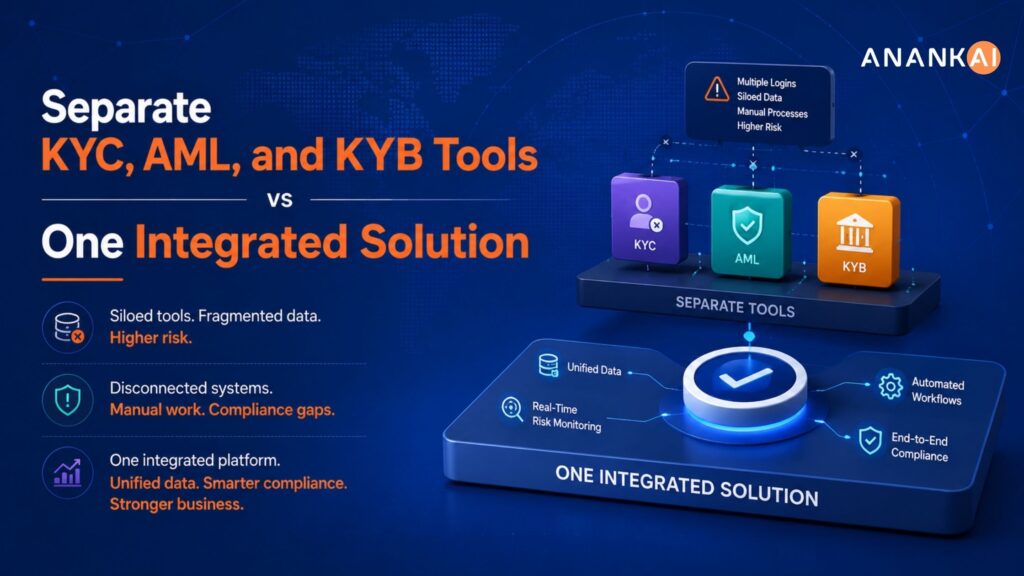
Separate Tools vs One Integrated Platform
| Decision Factor | Separate Tools | Integrated Platform |
|---|---|---|
| API integrations | Multiple integrations | Single integration |
| Vendor management | Multiple contracts and support agreements | One commercial relationship |
| Data flow | Cross-system synchronisation | Unified data model |
| Platform maintenance | Independent upgrade cycles | Single release cycle |
| User experience | Multiple dashboards | One operational workspace |
| Time to deployment | Longer implementation | Faster implementation |
Why Fragmented Compliance Workflows Create Operational Challenges
Compliance activities rarely operate independently.
Customer onboarding, identity verification, transaction monitoring, sanctions screening, and case investigations all rely on shared customer information.
When these functions are distributed across separate systems, organisations may face challenges such as:
Duplicate customer records
Manual data reconciliation
Disconnected case investigations
Increased engineering maintenance
Limited operational visibility
A connected platform enables compliance teams to work from a single source of truth, improving collaboration across onboarding, operations, and risk teams.
What Technology Buyers Should Evaluate
1. Total Cost of Ownership
Beyond licence fees, consider:
Integration effort
Engineering resources
Ongoing maintenance
Vendor management
Operational efficiency
The lowest subscription price does not always result in the lowest long-term cost.
2. Time to Production
Implementation timelines can significantly affect product launches.
Evaluate:
Integration complexity
API maturity
Documentation quality
Sandbox availability
Migration effort
A modular platform with unified APIs can help reduce implementation complexity.
3. Operational Efficiency
Ask whether your platform provides:
Unified customer profiles
Shared compliance data
Automated workflow orchestration
Integrated case management
Centralised reporting
These capabilities can reduce manual work and improve operational visibility.
Why Organisations Choose an Integrated Platform
Many financial institutions prefer integrated platforms because they simplify technology management while supporting future growth.
A modern platform should provide:
Unified KYC, KYB and AML workflows
API-first architecture
Configurable compliance workflows
Centralised case management
Real-time monitoring
Audit trails
Reporting dashboards
Enterprise-grade security
How AnankAI Supports Connected Compliance Workflows
AnankAI provides technology infrastructure that brings together digital wallets, payment processing, customer onboarding, compliance workflows, AML monitoring, reporting, and operational dashboards within a single platform.
Key capabilities include:
Unified API architecture
Integrated KYC, KYB and AML workflows
Centralised case management
Configurable workflow automation
Real-time operational dashboards
Multi-currency wallet infrastructure
Payment connectivity
Comprehensive audit trails and reporting
By consolidating these capabilities into one technology platform, organisations can simplify integration, improve operational visibility, and create a more connected financial services environment.
Final Thoughts
Choosing between separate compliance tools and an integrated platform is about more than software procurement.
It’s a strategic technology decision that influences operational efficiency, engineering effort, customer experience, and future scalability.
For organisations looking to simplify financial operations, an integrated platform can provide a more connected foundation for digital payments, wallet management, compliance workflows, and reporting.
Interested in seeing how a unified platform could fit your technology strategy?
Request a personalised demonstration of the AnankAI platform.