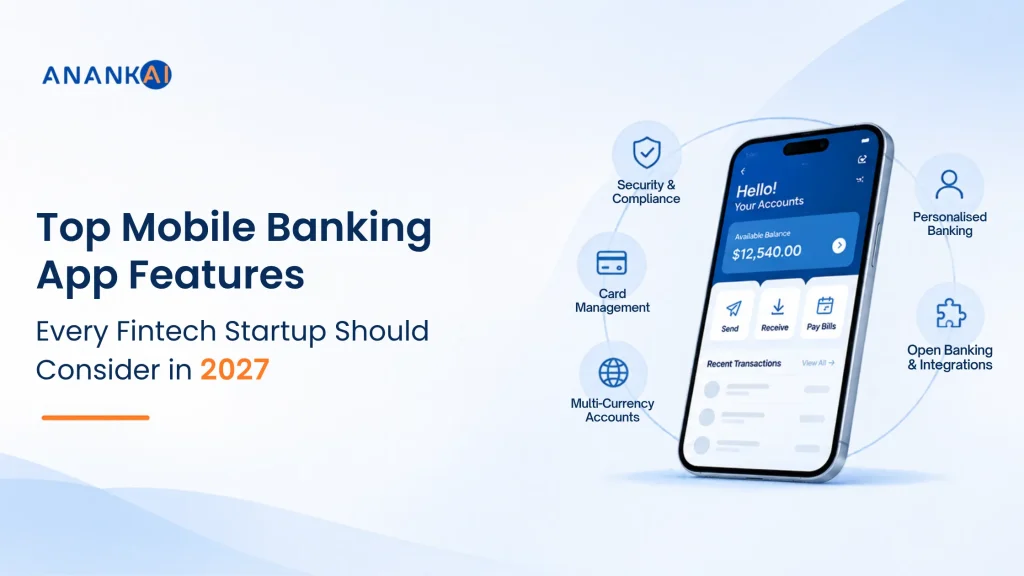
This guide covers the essential mobile banking app features to prioritise in 2027, from digital account management and payments to security, personalisation and automation.
Top 10 Mobile Banking Features to Consider (2027)
1. Digital Account Opening and Customer Onboarding
Customers expect to open an account without visiting a branch or completing lengthy paperwork. A smooth onboarding process can reduce drop-offs and help fintechs acquire customers more efficiently.
Essential features include:
- Digital registration and identity verification
- Electronic document submission
- KYC and KYB verification workflows, where applicable
- Automated application status updates
- Clear explanations when additional information is required
Startups should design onboarding around their target markets, identity verification requirements, and regulatory obligations.
2. Real-Time Account Balances and Transaction History
Customers need an accurate view of their money. The app should display available balances, recent transactions, and transaction statuses clearly.
Consider including searchable transaction histories, downloadable statements, transaction references, and notifications for completed or failed payments.
For a better experience, distinguish between pending transactions, completed payments, and reversed transactions. The displayed information should reflect the underlying ledger and payment provider data rather than relying solely on app-side updates.
3. Seamless Payments and Money Transfers
Payments are a core feature of most mobile banking products. The required payment methods will depend on the countries served, customer segments, and financial partners.
Useful capabilities include:
- Domestic bank transfers
- Peer-to-peer transfers
- Scheduled and recurring payments
- Beneficiary management
- Payment confirmations and receipts
- International transfers and currency conversion, where supported
Startups should also consider transfer limits, fee disclosures, exchange rates, failed-payment handling, and refunds or reversals. Clear status updates help customers understand where their money is throughout a transaction.
4. Card Management and Digital Wallets
For apps offering payment cards, customers should be able to manage their cards without contacting support for routine requests.
Important features include virtual and physical card management, card activation, PIN management, temporary card freezing, replacement requests, and spending controls.
Integration with supported digital wallets can also make contactless payments more convenient. Features such as tokenisation and card controls should be implemented in coordination with the relevant issuer and card programme provider.
5. Strong Authentication and Fraud Prevention
Security must be part of the app’s architecture from the beginning, not an additional feature introduced before launch.
Consider biometric authentication, multi-factor authentication, secure session management, device registration, transaction alerts, and risk-based authentication for sensitive actions.
Fraud monitoring can help identify unusual transactions or suspicious activity. Where appropriate, the system should support transaction limits, alerts, account restrictions, and escalation to a human review team.
The OWASP Mobile Application Security Verification Standard provides a useful framework for assessing mobile security, including authentication, data storage, cryptography, network communication, and privacy. Read the OWASP MASVS guidance.
6. Personal Finance Management
Customers benefit when banking apps help them understand their spending, not just view their balances.
Useful features include spending categories, monthly summaries, savings goals, budget alerts, and recurring payment insights.
For example, a customer could receive a notification when spending in a selected category exceeds a monthly budget. Over time, these insights can make the app more useful and encourage regular engagement.
Start with accurate categorisation and clear reporting before introducing advanced recommendations.
7. Push Notifications and Customer Support
Timely notifications keep customers informed about important account activity. These may include payment confirmations, low-balance alerts, card transactions, security warnings, and upcoming bills.
Support features should include searchable FAQs, in-app messaging, service request tracking, and access to a human support representative when necessary. Clear complaint-handling and escalation processes are particularly important for financial services.
8. Open Banking and Third-Party Integrations
Open banking and API integrations can extend an app’s capabilities beyond its own accounts and services, subject to the relevant market, permissions, and provider arrangements.
Depending on the product, integrations may support external account information, payment initiation, identity verification, card issuing, transaction monitoring, and accounting services.
A modular API architecture can help startups introduce new features without rebuilding the entire application. However, every integration should be assessed for reliability, data permissions, security, service availability, and ongoing cost.
9. Accessibility and Multilingual Support
A banking app should be usable by customers with different abilities, devices, and levels of digital confidence.
Prioritise readable text, sufficient colour contrast, screen-reader compatibility, clear navigation, and accessible authentication flows. Multilingual interfaces can also help fintechs serve customers across different markets.
10. AI-Powered Features and Automation
By 2027, fintech startups may increasingly consider AI-powered support and personalised financial insights. Practical use cases include conversational assistance, transaction categorisation, suspicious activity prioritisation and tailored spending summaries.
These features should be introduced where they solve a clear customer or operational problem. Financial information must remain accurate, and AI-generated guidance should not replace required checks or make consequential decisions without appropriate controls.
Startups should also establish data protection safeguards, explain limitations, and provide a route to human support.
How Should Fintech Startups Prioritise These Features?
Not every feature needs to be available on day one. A practical rollout can help control development costs while keeping the product useful.
Phase 1: Core banking experience
Prioritise onboarding, account balances, transaction history, payments, authentication, security alerts, and customer support.
Phase 2: Product expansion
Introduce card management, digital wallets, scheduled payments, personal finance tools, and additional integrations according to customer demand.
Phase 3: Differentiation and automation
Evaluate AI-powered assistance, advanced personalisation, expanded open banking capabilities, and more sophisticated fraud analytics.
The exact sequence depends on the product, operating markets, regulatory obligations, and financial service providers involved.
Build a Mobile Banking App That Can Grow With Your Business
A successful mobile banking app combines convenient customer experiences with reliable transaction processing, security, and operational controls. The priority is to build the capabilities customers need today while keeping the technology flexible enough to support future services.
AnankAI provides modular fintech technology for businesses developing digital banking, wallet, and payment products. Explore the AnankAI platform to see how its capabilities could support your mobile banking product requirements.
For more information, contact us.