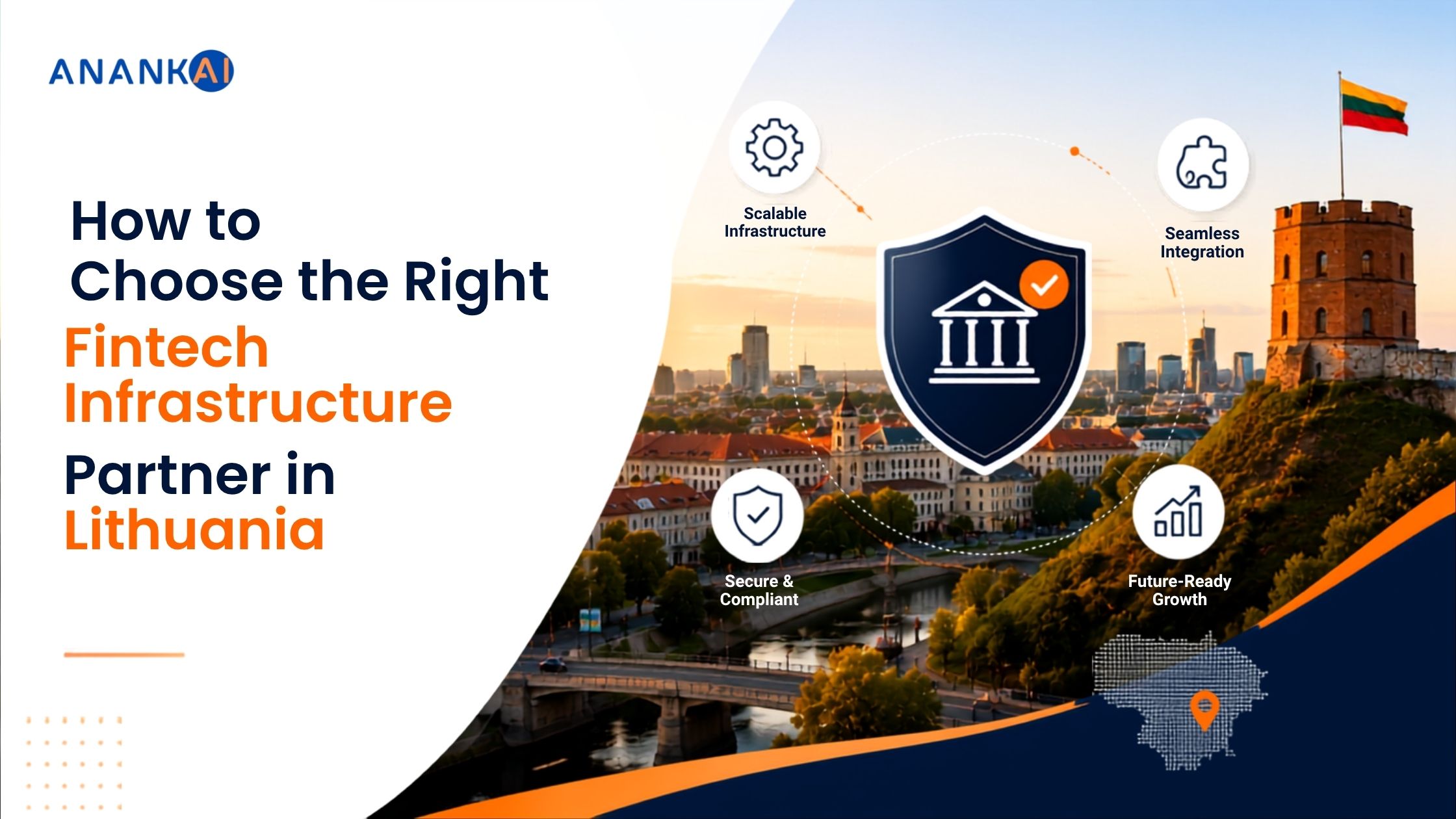
Launching a fintech in Lithuania is easier than it was a few years ago. But scaling it successfully is not!
Lithuania has established itself as one of Europe’s leading fintech hubs, attracting payment institutions, electronic money institutions (EMIs), and Banking-as-a-Service (BaaS) providers looking for access to the European market. While the country offers a supportive regulatory environment and strong digital infrastructure, choosing the right fintech infrastructure partner has become more important than ever.
Read this blog to learn about the factors to consider when choosing the right fintech infrastructure partner in Lithuania.
Factors to Consider When Choosing a Fintech Partner in Lithuania
1. Regulatory expertise
A strong fintech infrastructure partner should understand Lithuania’s regulatory landscape inside out. The Bank of Lithuania has built a reputation for supporting innovation while maintaining high supervisory standards. However, obtaining and maintaining an EMI or payment institution licence requires ongoing compliance with regulations covering anti-money laundering (AML), operational resilience, safeguarding customer funds, and governance.
AML, or Anti-Money Laundering, refers to the processes businesses use to detect and prevent financial crime such as fraud, money laundering, and terrorist financing. Rather than leaving these responsibilities to individual teams, a capable infrastructure partner should build compliance into the platform through identity verification, transaction monitoring, reporting, and audit trails. This reduces operational complexity and helps fintechs stay aligned with changing regulatory expectations across the European Union.
2. Technology that grows with your business
Launching quickly is important, but so is preparing for future growth. Many fintechs begin with a narrow product offering before expanding into new markets, adding payment methods, or introducing embedded finance services. Infrastructure that cannot scale often leads to expensive migrations and operational disruption later.
Look for a partner that offers modular, API-first infrastructure. An API (Application Programming Interface) allows different software systems to communicate securely without requiring businesses to build every connection themselves.
A modular platform enables fintechs to introduce new products, integrate specialist providers, or expand into additional European markets without rebuilding their core systems.
3. Integration without unnecessary complexity
Nowadays, modern fintech operations rely on multiple specialist providers. Customer identity verification, sanctions screening, fraud prevention, payment processing, card issuing, and customer communication are often delivered by different vendors. Managing these integrations individually can become time-consuming and difficult to maintain.
An effective fintech infrastructure partner simplifies this ecosystem by providing a unified integration layer. Instead of connecting separately to every provider, fintechs can manage workflows through a single platform. This approach reduces implementation time, improves consistency across customer journeys, and makes it easier to replace or add providers as business requirements evolve.
4. Operational resilience and security
Financial services depend on trust. Customers expect payments to be processed reliably, personal information to remain secure, and services to be available whenever needed. This makes operational resilience an essential consideration when evaluating infrastructure providers.
Operational resilience refers to an organisation’s ability to continue delivering important services even when systems fail, cyber incidents occur, or unexpected disruptions arise.
Strong infrastructure partners invest in secure cloud architecture, continuous monitoring, disaster recovery planning, and data protection measures that support business continuity. As the European Union strengthens requirements around digital operational resilience, fintechs should ensure their technology partners are prepared to meet these expectations rather than treating resilience as an afterthought.
5. Long-term partnership beyond implementation
Technology alone rarely determines long-term success. Fintech businesses operate in a rapidly changing environment where regulations, customer expectations, and market opportunities evolve continuously. A valuable fintech infrastructure partner should support businesses throughout that journey rather than only during implementation.
This includes helping teams adapt to regulatory updates, optimise operational processes, integrate new services, and expand into additional jurisdictions when required. Partners with experience across different fintech business models can also provide practical guidance based on previous implementations, reducing the learning curve for growing companies. Choosing a provider that understands both technology and financial services creates a stronger foundation for sustainable growth.
Conclusion
Lithuania continues to strengthen its position as a gateway for fintech innovation within Europe. As competition increases and regulatory expectations become more sophisticated, infrastructure decisions will play a larger role in determining how quickly fintechs can adapt and grow. Selecting a partner with proven regulatory knowledge, scalable technology, seamless integrations, resilient operations, and long-term industry expertise helps businesses focus on building better financial products rather than managing technical complexity.
For fintechs evaluating their next stage of growth in Lithuania, choosing the right infrastructure partner is a strategic decision rather than simply a technology purchase.
If you’re exploring a modern fintech technology provider in Lithuania that supports compliance, scalability, and operational efficiency, AnankAI is available to discuss your requirements and help you assess the best approach for your business. For more details, contact us.